Fluidverse Stormwater Modules
50 to 5,000 m³+ · Modular underground storage · Infiltration, attenuation & reuse · Turnkey engineering across UAE & India
Fluidverse engineers, supplies and installs turnkey modular underground stormwater and rainwater management systems — from groundwater recharge pits to multi-thousand-cubic-metre attenuation tanks under car parks and podiums.
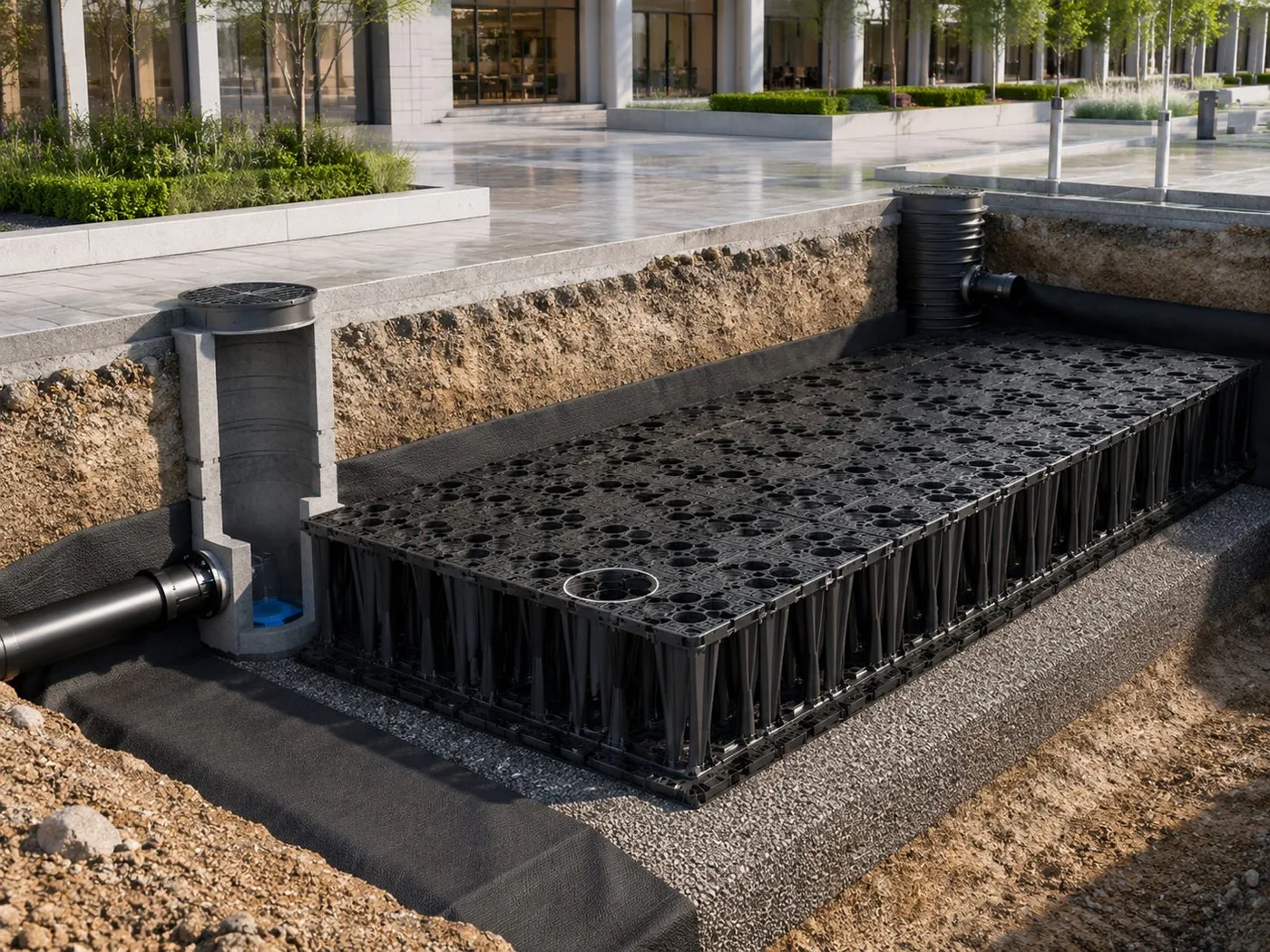
Top Panel
Column Module
Base Panel
Inlet / Outlet
Inspection Access
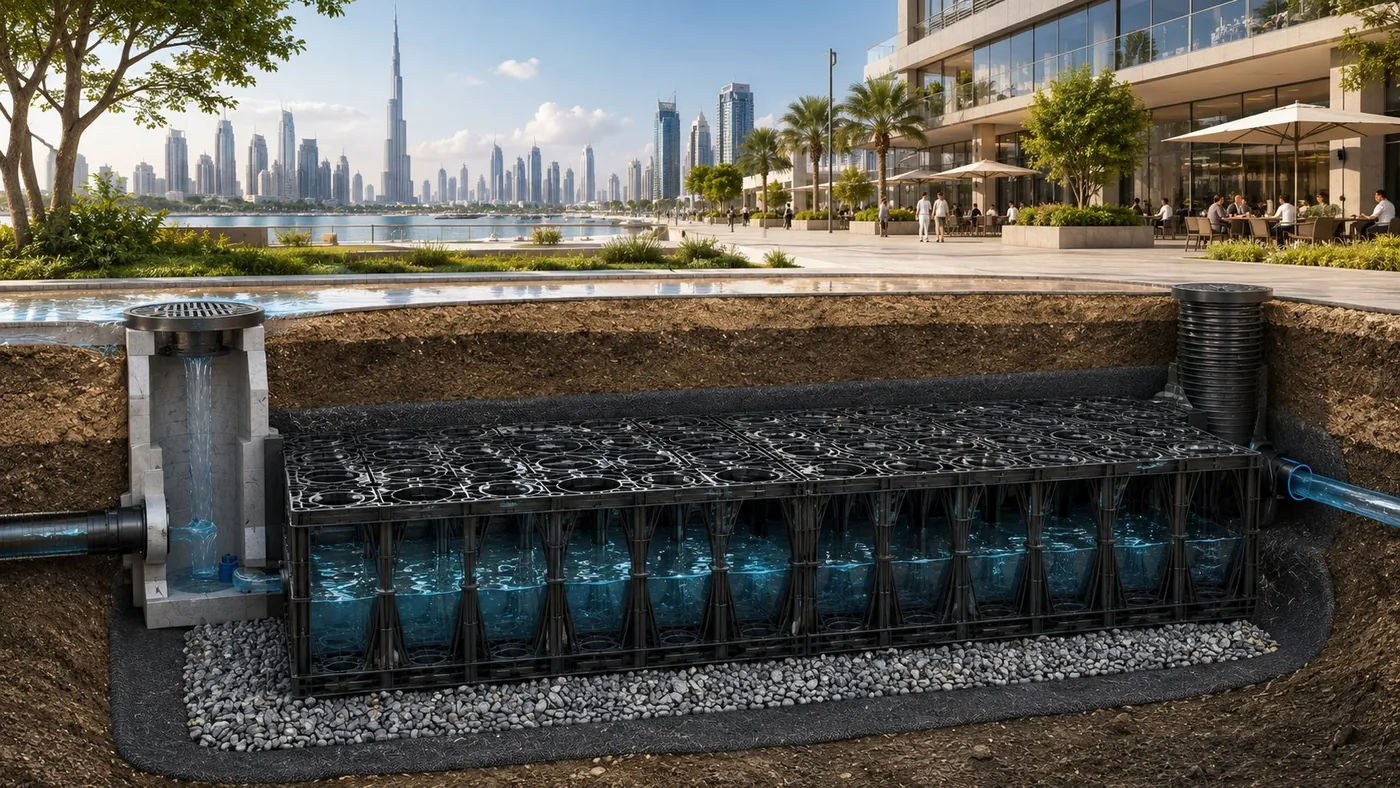
System visualisation
The System
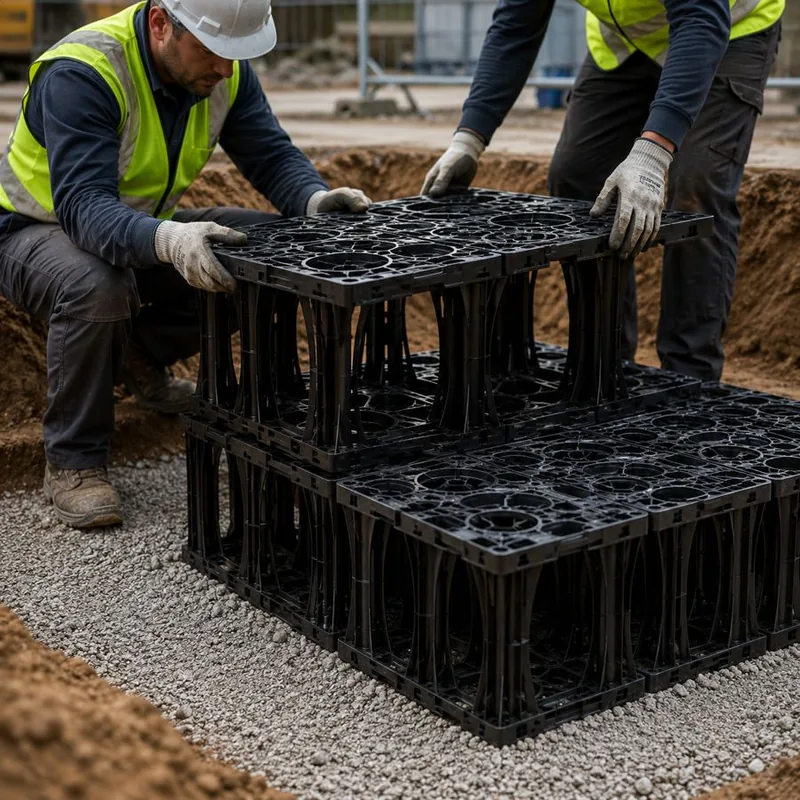
Interlocking modules assemble into underground storage structures of nearly any footprint and depth — expanding horizontally and vertically as the project demands.
Working Principle
Surface runoff is filtered and held in the module — then either percolated back to the ground, or stored and lifted for reuse.
Simplified schematic — pre-filtration, access points and pump duty are configured per project.
Surface runoff from roofs, car parks, roads and paved podiums is directed into the underground module system via existing drainage connections. Catchment from large commercial roofs is most efficient when paired with siphonic roof drainage systems to streamline collection into a centralized underground tank. The flow path follows a clean engineering sequence:
Every Fluidverse installation includes pre-filtration, access points and pump specification as part of the core project design — not as optional extras.
Applications
Beneath the City
System visualisation
The module system is wrapped in a permeable geotextile. Surface runoff filters down through the soil, recharging the water table below. This approach is used where soil permeability allows and regulatory requirements mandate groundwater replenishment — common in Indian metropolitan areas where municipalities require recharge structures as a condition of building plan approval. The 95% void ratio of the modules maximises storage volume within a compact footprint, allowing deep percolation without the land area that conventional soakaway pits require.
The module system is wrapped in an impermeable geomembrane, creating a watertight underground tank. During heavy rainfall, runoff is captured and held in the system. A controlled outlet — orifice plate, throttle valve or pumped discharge — releases the stored water at a rate the downstream drainage network can accept, eliminating the peak flow spikes that cause flooding. In the UAE, where intense wadi-style flash floods can overwhelm municipal drains within minutes, underground attenuation beneath car parks and podium slabs is increasingly specified by Dubai Municipality and Abu Dhabi Department of Energy in commercial development approvals.
Rainwater captured from roof catchment areas is pre-filtered — through a first-flush diverter and filtration unit — before entering the underground storage system. The stored water is then lifted by pump to end-use points: irrigation, cooling towers, toilet flushing, vehicle washing and process water. For commercial buildings in Indian cities where rainwater harvesting is mandatory (including Bengaluru, Chennai, Delhi and Ahmedabad), a properly sized modular storage system integrated with the building's plumbing reduces potable water demand by 40–60%. In the UAE, harvested rainwater supplements limited water resources and supports green building certification requirements including Estidama Pearl Rating and LEED v5.
Deep dive into hydraulic sizing calculations, CIRIA C753 SuDS standards, geomembrane welding protocols, and geotextile filtration for high-load installations.
Product Platform
Fluidverse engineers, supplies, and installs high-strength geocellular stormwater modules across the UAE and India. Engineered for heavy underground stormwater attenuation and infiltration, the system is available in Standard Duty (SD) for landscaped and podium areas, and Heavy Duty (HD) for traffic-bearing surfaces including car parks, logistics hubs, airports, and highway corridors.
Fluidverse operates across the UAE (Dubai, Abu Dhabi) and India (Delhi NCR, Mumbai, Bengaluru), delivering the full turnkey project scope: site-specific hydraulic sizing, excavation coordination, structural module assembly, geomembrane and geotextile encapsulation, inlet/outlet integration, silt-trap filtration, access chamber positioning, and final authority handover.
Modular geocellular crate architecture
Regional Framework
Navigating municipal stormwater detention mandates in the Gulf and statutory rainwater harvesting regulations across Indian states.
The UAE government's Tasreef infrastructure program and ongoing updates to Dubai Municipality stormwater guidelines reflect a growing mandate for on-site stormwater management in commercial development. Flash flooding events — particularly in Dubai and Sharjah — have reinforced requirements for underground detention under car parks and podiums in new commercial projects.
Stormwater systems must be designed and validated by chartered engineers and submitted to the relevant authority (Dubai Municipality, Abu Dhabi Department of Energy, or Trakhees) as part of building permit documentation. Fluidverse engineers prepare all hydraulic calculations and technical documentation required for regulatory submission for commercial stormwater management in the UAE.
Rainwater harvesting is legally mandated for commercial, institutional and large residential buildings in most major Indian cities under local municipal building by-laws and state water policies:
Fluidverse provides complete rainwater harvesting system design in India and technical submittal documentation for municipal authorities and CGWA approvals.
Engineering Data
Technical performance matrix for civil engineers, MEP consultants and project contractors.
| Parameter | Specification & Engineering Standard |
|---|---|
| Module void ratio | >95% usable volume for water storage |
| Storage range | Compact recharge pits → 5,000 m³+ multi-tier installations |
| Module type | Modular Geocellular Polypropylene SD (Standard Duty) / HD (Heavy Duty) |
| Traffic load rating (HD) | Tested and certified for airports, highways, and commercial car parks |
| Design life | 50–60 years; recyclable high-grade polypropylene construction |
| Wrap options | Permeable non-woven geotextile (infiltration) / Impermeable geomembrane (attenuation & harvesting) |
| Access & maintenance | CCTV and jetting-compatible throughout; inspection access chambers at inlet, outlet and mid-span |
| Applications | Under car parks, podiums, landscaping, service roads, sports surfaces |
| Configurations | Infiltration · Attenuation (detention) · Harvesting (reuse) · Combined hybrid systems |
| CAD drawings & calculation | Full hydraulic sizing and shop drawings provided at specification stage |
| Countries served | United Arab Emirates · India · Wider GCC Region |
All structural calculations and loading simulations conform to CIRIA C737 standards for underground geocellular systems.
Installation
Fast installation with minimal site disruption — with layout guidance, assembly support or full turnkey execution from Fluidverse.
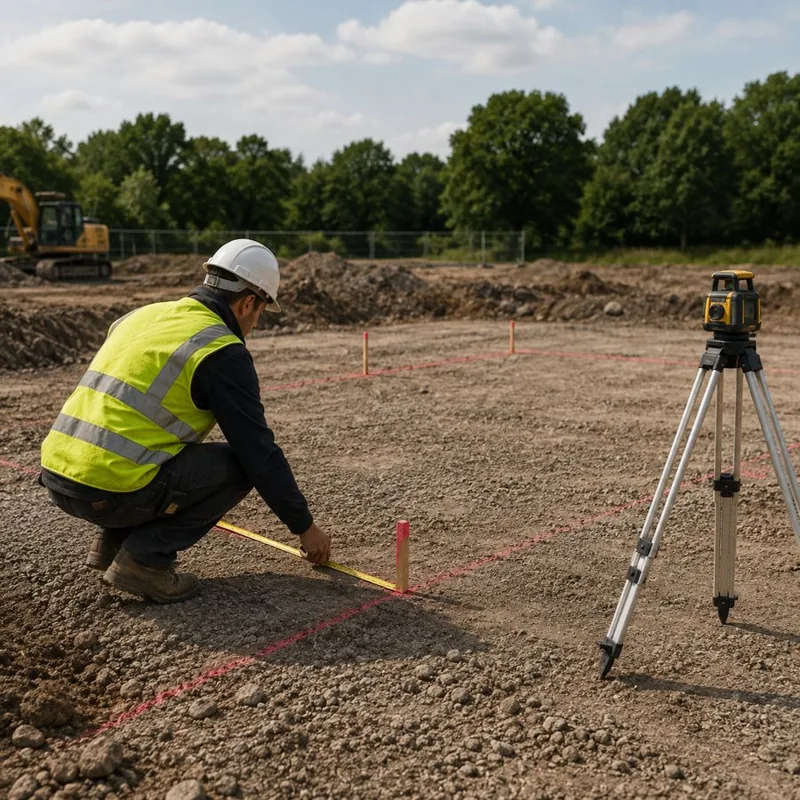
Confirm levels, inverts and footprint. Set out the system location.

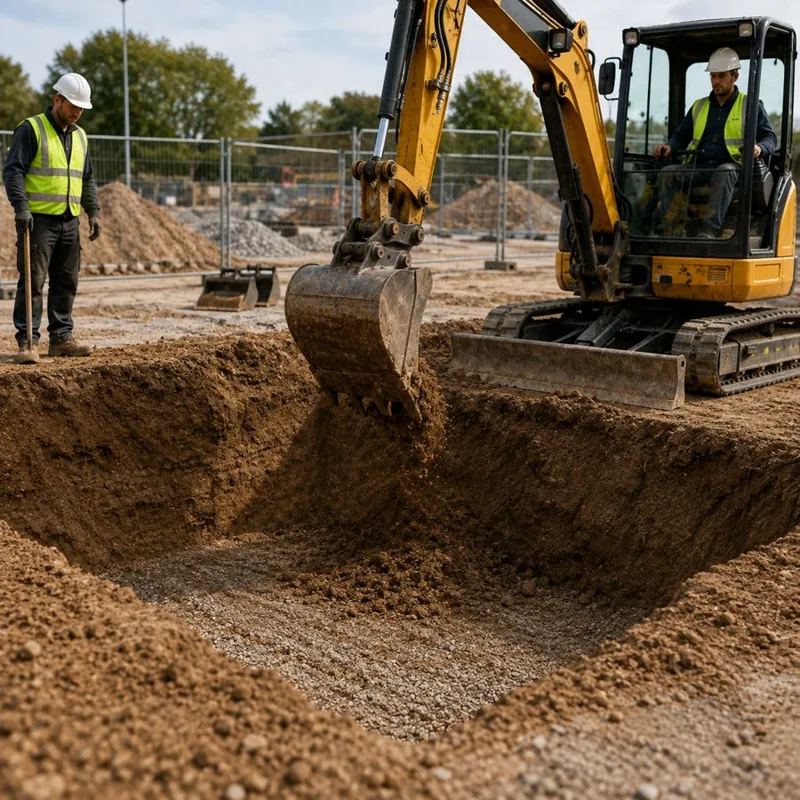
Excavate to required depth with allowance for working space.

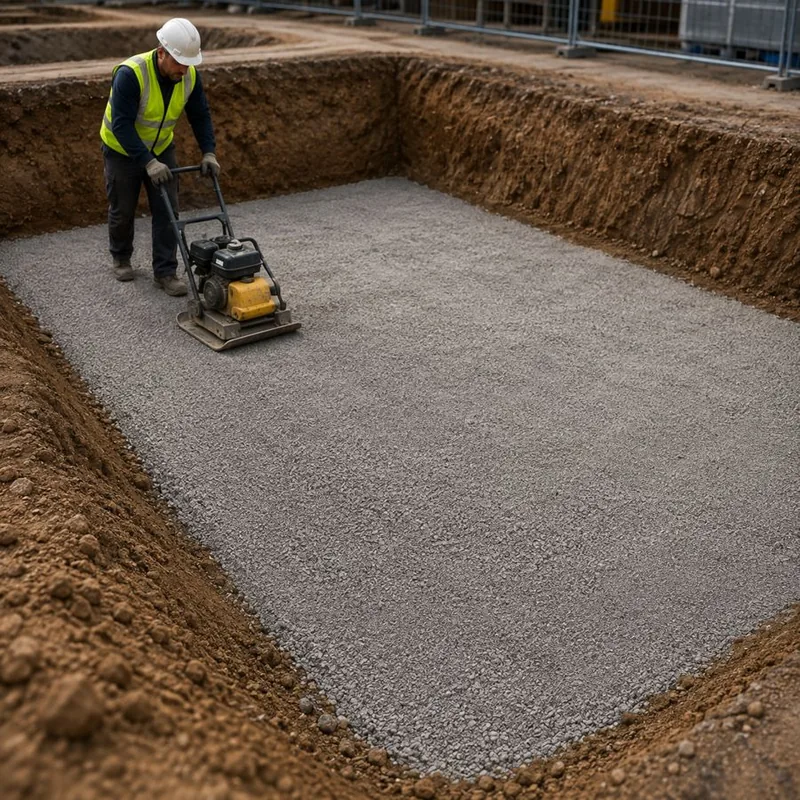
Level, compacted base with specified aggregate thickness.

Assemble modules on the prepared base per system design.

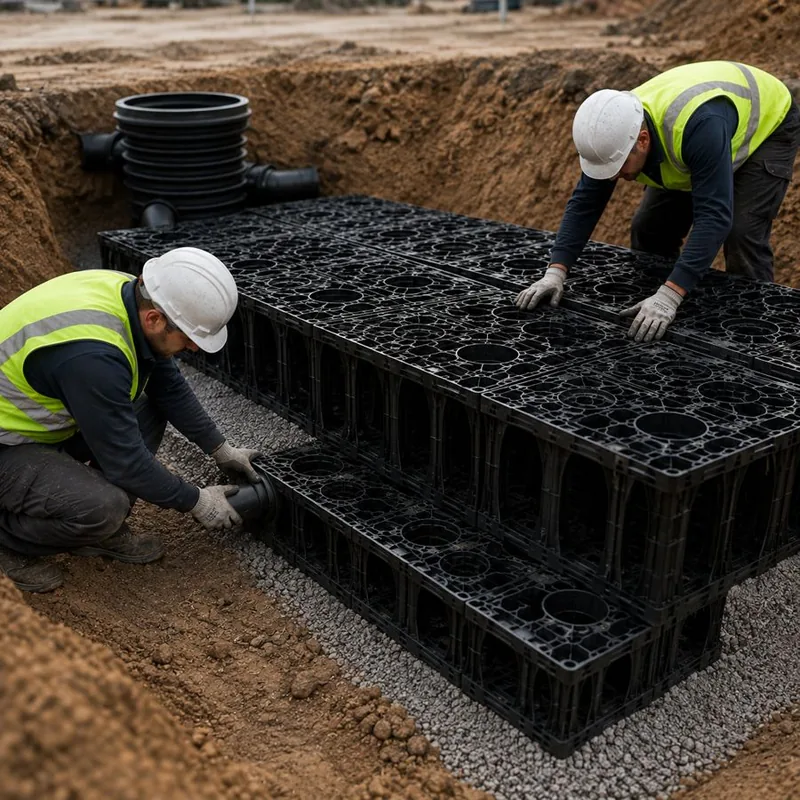
Position modules and align inlet / outlet connections.

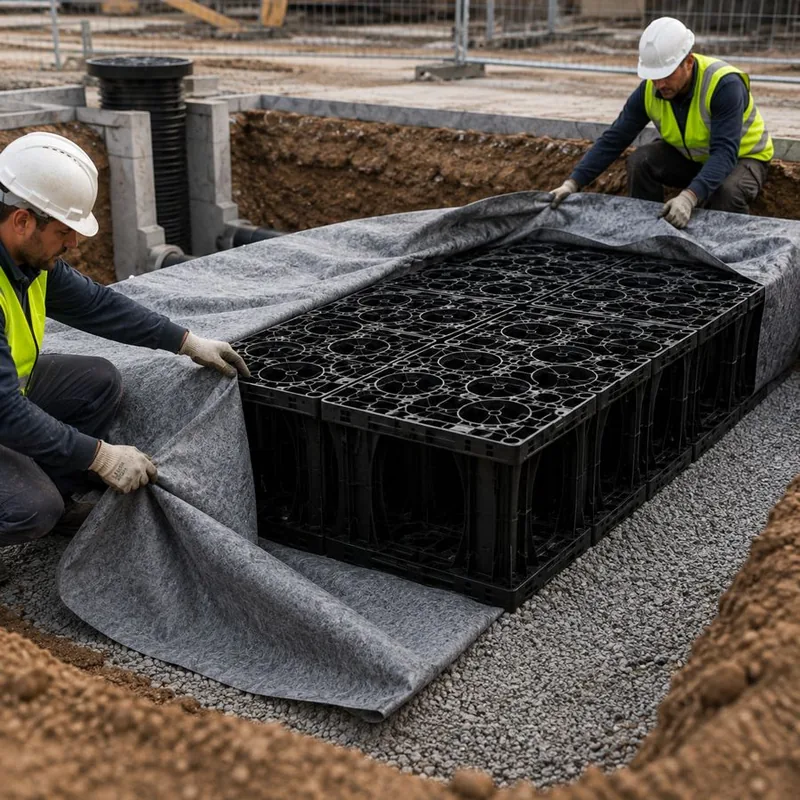
Wrap with geotextile or liner to prevent soil ingress.

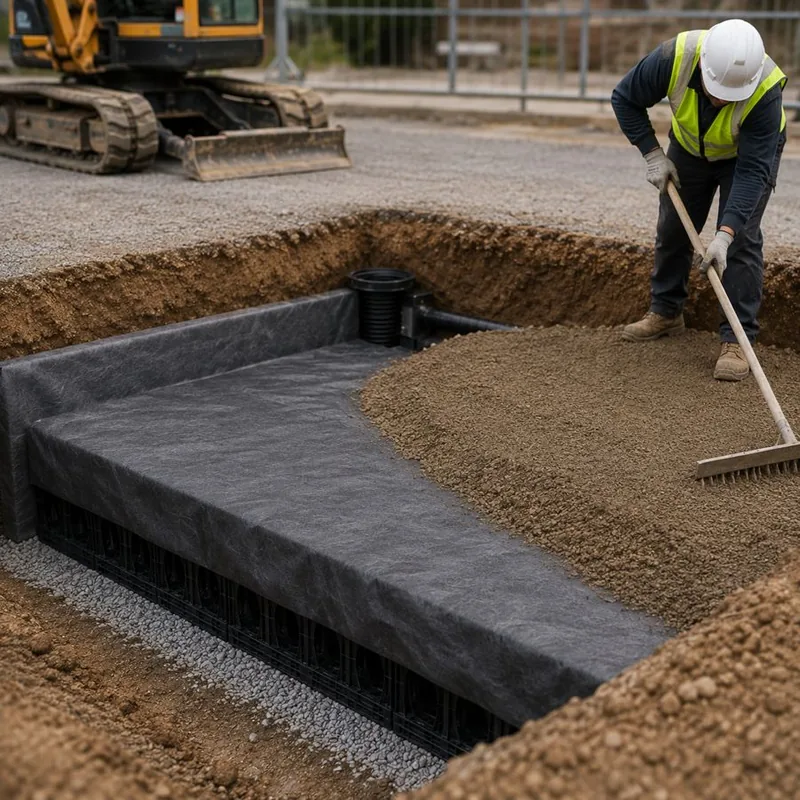
Backfill in layers, compact and restore surface levels.

Fully reinstated, with access points for inspection.

Quality & Confidence
Certified production systems and tested performance — giving consultants, developers and contractors confidence at specification stage.
Tested to relevant standards, supported by third-party product testing and quality-controlled production.
Engineered to site conditions and loading requirements for reliable long-term performance.
CAD drawings, specifications and installation guides provided at specification stage.
Fluidverse prepares full project documentation for each installation — including hydraulic design calculations, geotechnical review, CAD drawings, installation methodology statements, and regulatory submission packages where required. For consultants and contractors specifying at tender stage, we provide pre-design layouts and technical notes within 48 hours of receiving project parameters.
FAQ
Everything you need to know about underground modular stormwater management, detention systems, and rainwater harvesting across UAE & India.
Stormwater management focuses on controlling runoff — typically to prevent flooding and protect downstream drainage infrastructure. It includes detention (temporary storage and controlled release) and infiltration (returning water to the ground). Rainwater harvesting focuses on capturing rainfall for reuse — collecting, filtering and storing water for non-potable applications such as irrigation, toilet flushing, cooling towers or process water. The Fluidverse modular underground system supports all three strategies from a single platform: the geotextile or geomembrane wrapping, and the inlet/outlet configuration, determines which function the system serves.
Detention systems store stormwater temporarily and release it at a controlled rate — they empty completely between storm events. They are designed to reduce peak flow rates rather than to eliminate runoff. Retention systems hold water permanently or semi-permanently, either for infiltration into the ground or for reuse in the building. The Fluidverse system can be configured for either: an impermeable geomembrane wrap creates a detention or retention tank; a permeable geotextile wrap enables infiltration.
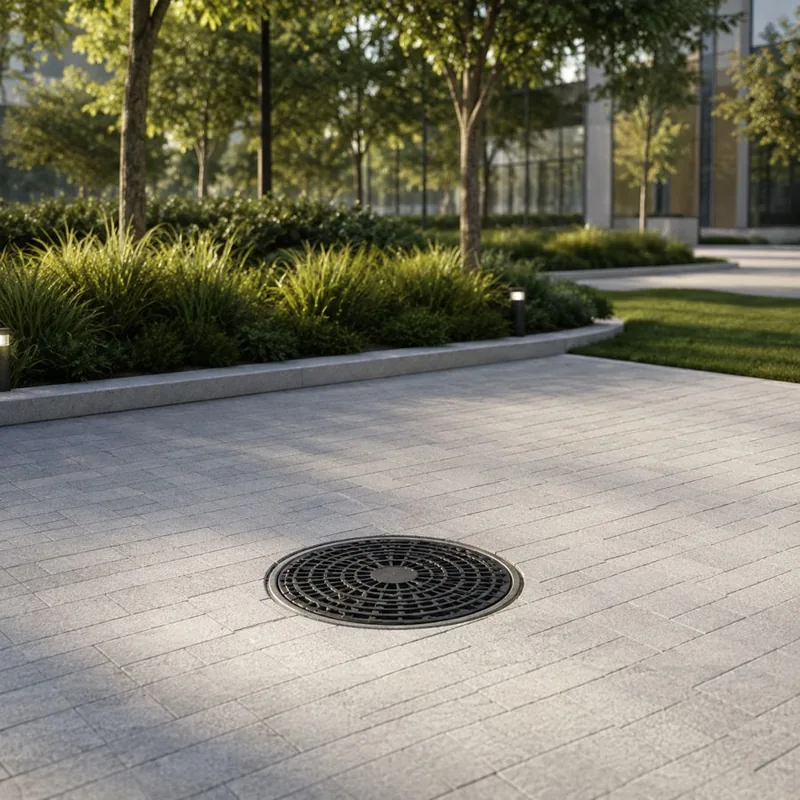
Modular geocellular crates are assembled in an excavated pit, wrapped in either geotextile (for infiltration) or geomembrane (for attenuation or harvesting), and backfilled. The interlocking modules create a structural underground void — with over 95% of the excavated volume available for water storage, far more efficient than aggregate-filled soakaways or conventional concrete tanks. Inlet and outlet pipes are integrated into the system design, along with access chambers for inspection and maintenance. The system is invisible at the surface, allowing full use of the area above for car parking, landscaping, roads or building podiums.
A stormwater infiltration module is a structural polypropylene crate that forms part of an underground soakaway system. Multiple modules are assembled into a block, wrapped in a permeable geotextile, and buried below ground. Collected stormwater enters the system and percolates through the geotextile into the surrounding soil, recharging groundwater. Fluidverse supplies Standard Duty (SD) geocellular infiltration modules for infiltration applications in the UAE and India. They achieve over 95% void ratio, meaning they store nearly all of the excavated volume as active water storage during each rainfall event.
The modules themselves are the same. The difference is how they are wrapped during installation: a permeable geotextile wrap creates an infiltration (soakaway) system, allowing water to seep into surrounding soil. An impermeable geomembrane wrap creates a watertight attenuation tank, holding water until it is discharged at a controlled rate. The decision between infiltration and attenuation is determined by soil permeability, groundwater level, regulatory requirements and whether the site has a compliant receiving outfall. Fluidverse assesses all four factors during the design phase.
Yes — in most major Indian cities, rainwater harvesting is legally required for commercial buildings above a threshold floor area or plot size. Requirements vary by municipal authority: Bengaluru (BBMP) mandates RWH for plots ≥ 2,400 sq. ft.; Chennai (CMWSSB) requires it for all plots > 60 sq. m.; Delhi (DJB) requires it for plots > 100 sq. m. The Central Ground Water Authority (CGWA) also requires demonstrated RWH provision as a condition for groundwater extraction NOCs. Fluidverse provides complete system design and documentation for all relevant municipal and CGWA submissions.
Yes — harvested rainwater in the UAE is suitable for non-potable applications including irrigation, cooling tower make-up, toilet flushing, vehicle washing and process water. Given the UAE's limited rainfall, underground storage is sized to capture the full runoff from roof catchment areas during each rainfall event, maximising collection from irregular but often intense storm events. Fluidverse designs the harvesting system around the site's catchment area, storage capacity and end-use demand profile.
Sizing involves three inputs: the catchment area (typically roof surface in m²), the local rainfall data (peak event volume and frequency), and the daily non-potable water demand the stored water will serve. For attenuation systems, sizing is driven by the allowable discharge rate (set by the drainage authority) and the peak rainfall intensity for the site's return period (typically 1-in-30 or 1-in-100 year storm). For projects specifying underground rainwater storage, Fluidverse engineers produce a full hydraulic calculation and system layout on receipt of the project brief — typically within 48 hours for standard commercial sites. Provide us with roof area, site location, and application (attenuation, infiltration or harvesting) to receive a sizing recommendation.
Yes — Fluidverse Heavy Duty (HD) geocellular modules are rated for traffic-bearing applications, including car parks, airports and highway margins. The structural design accommodates vehicle wheel loads and dead loads from the surface above. Fluidverse coordinates the installation with the civil contractor, providing a methodology statement and loading calculations as part of the project documentation package. In the UAE, under-podium and under-carpark installation is the most common application for commercial developments where surface detention is not viable.
Annual inspection is recommended. Maintenance includes CCTV inspection of inlet and outlet pipes, checking for sediment accumulation at the base of the system, and inspecting the access chambers. The open-cell architecture of Fluidverse modules allows jetting equipment to be moved throughout the system, not just at entry points — this is a key maintenance advantage over closed-cell crate systems. Pre-filtration at the inlet (included in every Fluidverse design) is the most important maintenance point: cleaning or replacing the pre-filter ensures sediment does not enter and compact within the modules over time.
System Sizing & Layout
From a compact recharge pit beneath a landscaped podium to a 5,000 m³ attenuation system under a car park — we design the system to the project, not the other way around. Provide catchment area, site location and the application (infiltration, attenuation or harvesting) and our engineers will return a layout and sizing recommendation within 48 hours.
Custom-engineered modular geocellular crate systems with >95% void ratio for infiltration, peak detention, and non-potable reuse across India and the UAE.